Wednesday, April 29, 2015

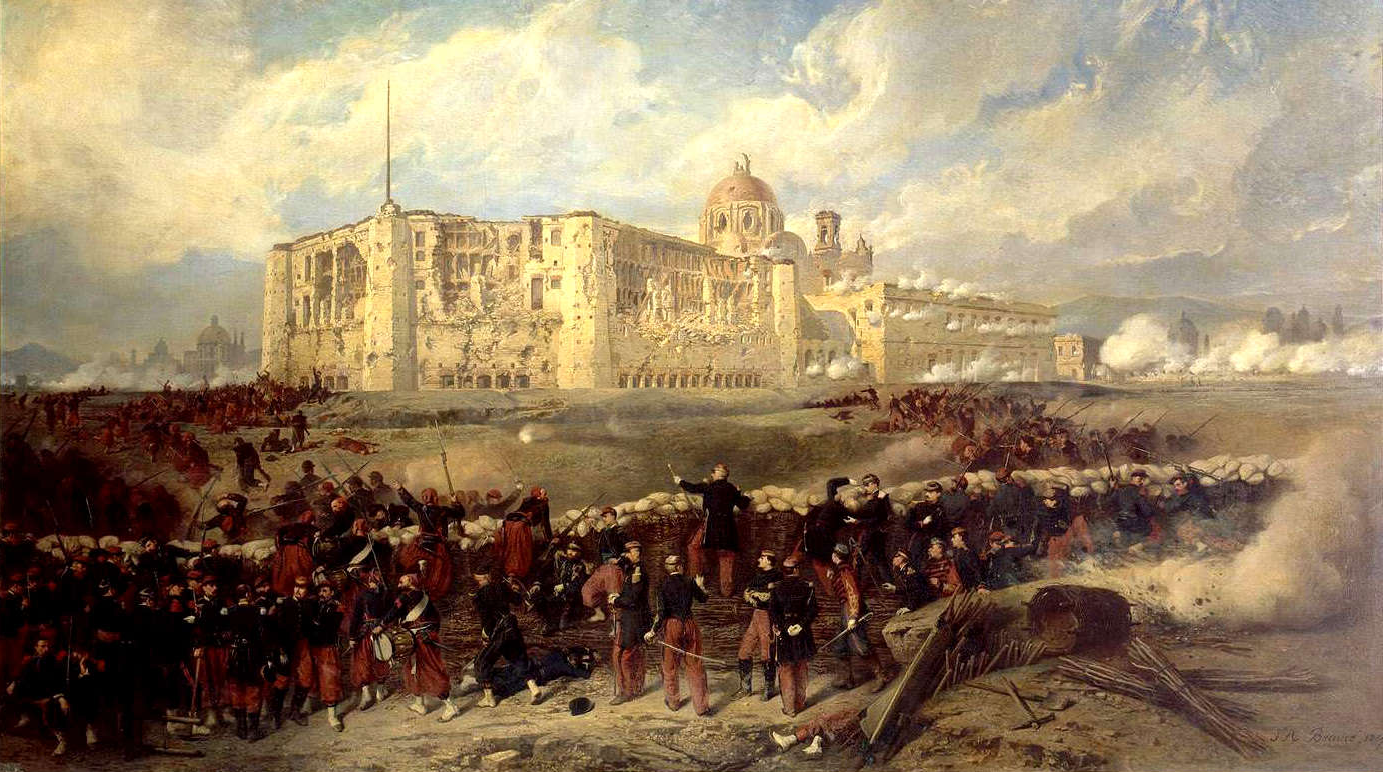
PUEBLA BATTLE

PUEBLA BATTLE

The Battle of Puebla took place on 5 May 1862 near the city of Puebla during the French intervention in Mexico. The battle ended in a victory for the Mexican Army over the occupying French forces. The French eventually overran the Mexicans in subsequent battles, but the Mexican victory at Puebla against a much better equipped and larger French army provided a significant morale boost to the Mexican army and also helped slow the French army's advance towards Mexico City.

French forces captured the city of Campeche on February 27 and reinforcements from France arrived soon after. By early March, France’s modern military machine had an efficient army in place, poised to capture Mexico City. Under the command of the Count of Lorencez, a veteran of the Crimean War, the French Army set out for Mexico City. When they reached Orizaba, they held up for a while, as many of their troops had become ill. Meanwhile, an army of Mexican regulars under the command of 33 year-old Ignacio Zaragoza marched to meet him. The Mexican Army was about 4,500 men strong: the French numbered approximately 6,000 and were much better armed and equipped than the Mexicans. The Mexicans occupied the city of Puebla and its two forts, Loreto and Guadalupe.

On the morning of May 5, Lorencez moved to attack. He believed that Puebla would fall easily: his incorrect information suggested that the garrison was much smaller than it really was and that the people of Puebla would surrender easily rather than risk much damage to their city. He decided on a direct assault, ordering his men to concentrate on the strongest part of the defense: Guadalupe fortress, which stood on a hill overlooking the city. He believed that once his men had taken the fort and had a clear line to the city, the people of Puebla would be demoralized and would surrender quickly. Attacking the fortress directly would prove a major mistake.

Lorencez moved his artillery into position and by noon had begun shelling Mexican defensive positions. He ordered his infantry to attack three times: each time they were repulsed by the Mexicans. The Mexicans were almost overrun by these assaults, but bravely held their lines and defended the forts. By the third attack, the French artillery was running out of shells and therefore the final assault was unsupported by artillery.

by. Aili Arias 3b 

Labor Day / May Day in Mexico

Labor Day / May Day in Mexico

Labor Day (Día del Trabajo), also known as May Day (Primero de Mayo), is a public holiday in Mexico on May 1.

Celebrate Labor Day

Labor Day parades, rallies or demonstrations often feature large crowds holding banners to promote workers’ rights in the main streets of major cities. Having the day off means people can either relax at home or spend time with family or friends. Leisure activities include going to the theatre or movies, or going out for coffee or a meal.

Public life

Labor Day is a federal public holiday in Mexico. Banks, schools, government offices and many businesses are closed. People intending on travelling via public transport in Mexico should check with public transit authorities on any timetable or route changes.

About Labor Day

Mexico’s labor movement was repressed in places such as Cananea in the north. However, the Constitution of 1917 instigated significant social reforms to labor laws. According to some sources, a Labor Day parade was held in Mexico as early as 1913, but the holiday was first officially commemorated on May 1, 1923. Labor Day is not exclusive to Mexico – many other countries also celebrate Workers’ Day.

Battle of Puebla

Cinco de Mayo is a Mexican holiday which celebrates the victory over French forces on May 5, 1862 at the Battle of Puebla. It is often mistakenly thought to be Mexico’s Independence Day, which is actually September 16. More of an emotional victory than a military one, to Mexicans the Battle of Puebla represents Mexican resolve and bravery in the face of an overwhelming foe.
The Battle of Puebla was not an isolated incident: there is a long and complicated history that led up to it. In 1857, the “Reform War” broke out in Mexico. It was a civil war and it pitted Liberals (who believed in separation of church and state and freedom of religion) against the Conservatives (who favored a tight bond between the Roman Catholic Church and the Mexican State). This brutal, bloody war left the nation in shambles and bankrupt. When the war was over in 1861, Mexican President Benito Juarez suspended all payment of foreign debt: Mexico simply did not have any money.
by:Amanda Berman, Sofia Carrillo, Claudia Flores 3B

Wednesday, April 22, 2015

Earth Day

Earth Day is an annual event, celebrated on April 22, on which day events worldwide are held to demonstrate support for environmental protection. It was first celebrated in 1970, and is now coordinated globally by the Earth Day Network,[1] and celebrated in more than 192 countries each year.]
In 1969 at a UNESCO Conference in San Francisco, peace activist John McConnell proposed a day to honor the Earth and the concept of peace, to first be celebrated on March 21, 1970, the first day of spring in the northern hemisphere. This day of nature's equipoise was later sanctioned in a Proclamation written by McConnell and signed by Secretary General U Thant at the United Nations. A month later a separate Earth Day was founded by United States Senator Gaylord Nelson as an environmental teach-in first held on April 22, 1970. Nelson was later awarded the Presidential Medal of Freedom Award in recognition of his work. While this April 22 Earth Day was focused on the United States, an organization launched by Denis Hayes, who was the original national coordinator in 1970, took it international in 1990 and organized events in 141 nations.Numerous communities celebrate Earth Week, an entire week of activities focused on environmental issues
By. Baudel Ruiz 1°B
Agregar leyenda

Earth Day!

Each year, Earth Day -- April 22 -- marks the anniversary of what many consider the birth of the modern environmental movement in 1970.
The height of hippie and flower-child culture in the United States, 1970 brought the death of Jimi Hendrix, the last Beatles album, and Simon & Garfunkel’s “Bridge Over Troubled Water”. Protest was the order of the day, but saving the planet was not the cause. War raged in Vietnam, and students nationwide increasingly opposed it.
At the time, Americans were slurping leaded gas through massive V8 sedans. Industry belched out smoke and sludge with little fear of legal consequences or bad press. Air pollution was commonly accepted as the smell of prosperity. “Environment” was a word that appeared more often in spelling bees than on the evening news.  Although mainstream America remained oblivious to environmental concerns, the stage had been set for change by the publication of Rachel Carson's New York Times bestseller Silent Spring in 1962.  The book represented a watershed moment for the modern environmental movement, selling more than 500,000 copies in 24 countries and, up until that moment, more than any other person, Ms. Carson raised public awareness and concern for living organisms, the environment and public health.
Earth Day 1970 capitalized on the emerging consciousness, channeling the energy of the anti-war protest movement and putting environmental concerns front and center.
By. Fernado and Jafet 3°B

Wednesday, April 15, 2015

Universal Children's Day

Universal Children's Day

Quick Facts

The United Nations' (UN) Universal Children's Day is an occasion to promote the welfare of children and an understanding between children all over the world. It is held on November 20 each year

Universal Children's Day 2015

Friday, November 20, 2015

The United Nations' (UN) Universal Children's Day, which was established in 1954, is celebrated on November 20 each year to promote international togetherness and awareness among children worldwide. UNICEF,promotes and coordinates this special day, which also works towards improving children's welfare.
 
In Mexico

Mother's Day and Father's Day are widely celebrated throughout the world. But Mexico is such an inclusive culture. Children's Day is always filled with activities, and children look forward to a holiday all their own with fun, gifts and special events.
Many schools celebrate the day before and parents are invited. Of course, there are usually no classes on Children's Day itself, April 30, even though it is not an official holiday in the school calendar.
On Children's Day, the main focus is on the children and making them feel special. In shopping malls all over Mexico, special events with clowns, magicians, music, shows and balloons take place. 

By. Sofia Carrillo and Valeria Duran 3°B

World Book Day

W O R L D   B O O K  D A Y.
World Book Day is a celebration! It’s a celebration of authors, illustrators, books and (most importantly) it’s a celebration of reading. In fact, it’s the biggest celebration of its kind, designated by UNESCO as a worldwide celebration of books and reading, and marked in over 100 countries all over the world.
This is the 18th year there’s been a World Book Day, and on 5th March 2015 children of all ages will come together to appreciate reading. Very loudly and very happily. The main aim of World Book Day in the UK and Ireland is to encourage children to explore the pleasures of books and reading by providing them with the opportunity to have a book of their own. 

By: Aili Arias
     Amanda Berman
     Claudia Flores
     3B sec.

Superman's

Superman's origin story is clearly inspired from that of Moses in the Abrahamic religions. Similar to Moses, Superman is sent far from his birthplace by his parents in the hope that he will have a better chance to live. A native of the distant planet Krypton, Superman is adopted by human parents and given the name Clark Kent; as he grows up, he discovers his Kryptonian heritage and attempts to bridge the differences between his two cultures. This aspect of Superman's story references the American ideal of E Pluribus Unum, the idea that our commonalities as Americans supersede our individual differences. To push the metaphor even further, Superman is technically an immigrant to the United States; his origin story emphasizes that any person can eventually be accepted as American, even if they were (literally) an alien from another planet. It is especially important for us to reflect on this concept as our nation decides the future of immigration reform; regardless of our policy preferences, we must remember that the promise of acceptance represented by Superman is essential to our nation's identity.
In continuing the trend of Biblical inspirations, Superman is often portrayed as a Christ figure. The Man of Steel emphasizes the universalist, redemptive aspect of the Jesus parallel; in the new film, Superman's father Jor-El narrates that Krypton was doomed as a result of its people's own hubris and avarice. By stripping their civilization of all morality and prioritizing technology as an end in and of itself, its people destroyed their own planet in a quest for natural resources. Therefore, Superman is sent to Earth to prevent humans from making the same mistakes as the Kryptonians. This is analogous to both Christian and Muslim understandings of Jesus as an individual sent by God to steer humans back towards His original message and away from desiring only worldly possessions. Also, just as Satan tempts Jesus with the promise of wealth and power, the film's antagonist General Zod tempts Superman to rule Earth using his near-invulnerability and superhuman abilities. Instead, Superman displays humility and strives to motivate each human to pursue good. Superman's human upbringing has taught him to control not only his abilities, but also his human emotions. In one scene, a young Clark Kent refuses to fight back despite being tormented by bullies; in this way, he shows the importance of Jesus's message of "turning the other cheek" and that violence should only be a last resort for solving problems.
These references to Jesus are also reflective of America's heritage, since our Founding Fathers were strongly influenced by Europe's Enlightenment and its Judeo-Christian tradition. They envisioned an enlightened society governed by science and rational thought, but also highly valued the presence of morality in creating a more perfect union. Also, by contrasting Superman with the violent General Zod, the film demonstrates the dangers of power without restraint. That inherent fear led the Founding Fathers to devise the system of checks and balances that still exists, mostly in its original form, in the contemporary U.S. government.
Another significant theme in The Man of Steel comes not from religion, but from classical philosophy. According to Jor-El, one of Krypton's weaknesses stemmed from state-sponsored genetic engineering, where all children were genetically bred for an eventual profession such as warrior, scientist, etc. This concept comes from Plato'sRepublic, where the ideal city "constructed in speech" would separate children from their parents and allow the state to decide their fate based on the "composition" of their soul. However, The Man of Steel argues against this so-called "perfect" society by demonstrating the problems with Krypton's approach. By removing the element of choice, Krypton doomed itself to an amoral, authoritarian system unable to respond to novel challenges such as the destruction of the planet itself. One of the hallmarks of the American mindset -- especially the liberal arts college -- is that people can reach their full potential when allowed the element of choice. Superman embodies this ideal, since as a superhuman being he chooses to help rather than rule mankind.
Superman has often fallen out of favor in the last few years because people cannot relate to him. However, the rebooted origin story of The Man of Steel film not only "updates" the Superman franchise into a serious, modern tone reminiscent of the Batman movies, but stays faithful to the amalgamation of religious and philosophical themes that made Superman one of the foremost symbols of American values. Although our nation remains intensely divided, we can all look up to Superman as what we can, and perhaps should be. Superman's greatness lies in his humility. As it goes with America: the famous political theorist Alexis de Tocqueville once wrote, "The greatness of America lies not in being more enlightened than any other nation, but rather in her ability to repair her faults." Let us hope we can repair our faults while staying true to the values that really make U.S. great.
By. Alejandro Saldaña 3°A

Wednesday, April 1, 2015

colors race


Spring

Spring is one of the four conventional temperate seasons, following winter and preceding summer. There are various technical definitions of spring, but local usage of the term varies according to local climate, cultures and customs. When it is spring in the Northern Hemisphere, it will be autumn in the Southern Hemisphere. At the spring equinoxdays are approximately 12 hours long with day length increasing as the season progresses. Spring and "springtime" refer to the season, and also to ideas of rebirth, rejuvenation, renewal, resurrection and regrowth. Subtropical and ​tropical areas have climates better described in terms of other seasons, e.g. dry or wet, monsoonal or cyclonic.

By. Ana Cecilia y Sofia 1ºA